Physical fitness is a way of describing what the body can do in everyday life, at work or during sports, as the physical fitness reference explains. A walk, a lift and a reach each ask something different of the person doing them. On a tennis court, getting to a wide ball involves speeding up, changing direction and staying steady enough to swing. Staying in play through a long match adds another demand. The terms below give those different capacities names.
Health-related components
Cardiorespiratory endurance
The Connecticut adapted physical education glossary defines cardiovascular endurance in terms of the heart, blood vessels and breathing system supplying oxygen and nutrients to working muscles. The term cardiorespiratory endurance emphasizes that breathing is part of the same process. The National Institute on Aging describes aerobic activity as using large muscles over a sustained period, with the lungs moving more air and the heart delivering more blood. Endurance concerns how long that demand can be sustained. The reference on aerobic intensity explains several ways sources describe how demanding an activity is at a given moment.
Muscular strength and muscular endurance
The strength training reference describes strength in terms of the force muscles can produce against resistance. A heavy lift asks for enough force to move the load. Repeated lifts add a question about how long the muscles can keep doing the work. That ability to sustain or repeat a muscular effort is muscular endurance, one of the qualities described in the circuit training reference. It is possible to talk about endurance in a particular muscle group, such as the legs over a series of stair climbs, as well as the endurance of the heart and lungs over a longer activity.
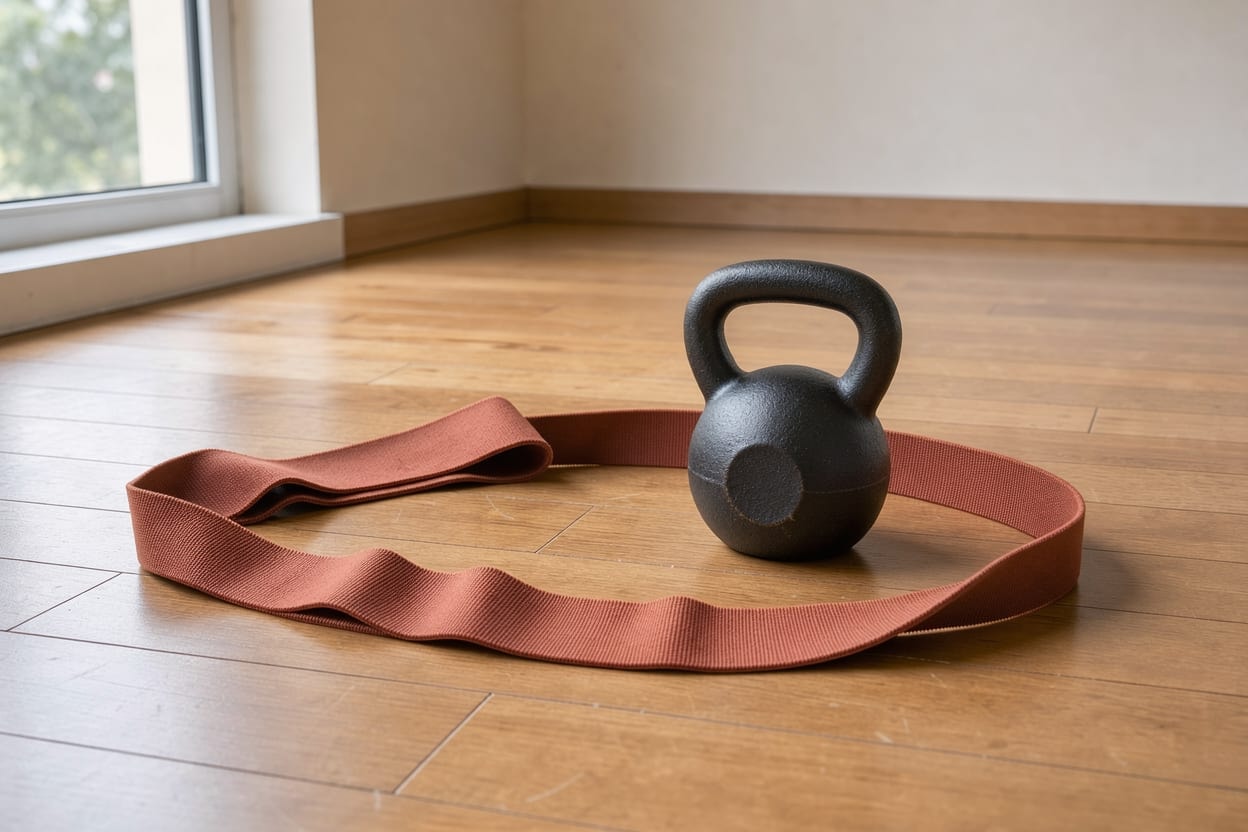
The National Institute on Aging's examples of muscle-strengthening activity include resistance bands, body-weight movements and carrying groceries. In a lift, a bag supplies the load. In a pushup, the person moves part of their own weight. A resistance band supplies force as it is stretched. The examples explain why the category covers more than using an exercise machine.
Flexibility
The National Institute on Aging defines flexibility as a joint's ability to move through its full range. Range of motion is the extent of the movement a joint allows. Touching the toes and bending to the side are different examples of stretching movements in the National Heart, Lung, and Blood Institute overview. A reach toward a low ball gives a picture of range in use. The player's ability to bend and reach, and the player's ability to hold a steady position during the reach, are separate parts of the same moment.
Body composition
The Connecticut glossary defines body composition as the relative amounts of fat mass and fat-free mass, which includes muscle, bone, organs and other tissues. Body weight is a total. Composition describes what makes up that total, so the same weight can represent different proportions. The same glossary defines body mass index separately as a relationship between height and weight.
Skill-related components
The personal training reference lists agility, coordination, power, speed and reactivity among the skill measures a trainer might consider. The Connecticut glossary defines balance and coordination separately. Consider how the terms apply to a player moving across a court.
- Agility
- Changing direction under control. A player moving toward the net who has to turn back to cover a deep groundstroke is an example of the quick movement and redirection involved in competitive tennis, where a 2007 review of tennis physiology identified agility among the demands of play in its published summary.
- Balance
- Keeping the body steady, both at rest and while moving, as the Connecticut glossary defines it. Setting up to receive a serve and remaining steady through a stretch for a wide ball illustrate static and moving balance.
- Coordination
- Combining movements smoothly and accurately, as defined in the Connecticut glossary. Tracking the oncoming ball while timing the swing brings vision and movement together.
- Power
- Producing force quickly, as in the explosive jumps described by the strength training reference. On court, the push that begins a sprint is a way to picture power in motion.
- Reaction time
- The interval from noticing a cue to beginning a response, an everyday way to understand the reactivity listed among skill measures. In a rally, it is the time between seeing where the opponent sent the ball and starting to move.
- Speed
- How quickly a movement is made, a distinct quality in the classification of exercise skills. Once a player starts after the ball, the pace of the run is an example of speed.
Reaction time and speed can be considered in sequence. A player might start early after reading a ball and then travel slowly, or start later and travel quickly. Separating those moments also keeps balance and agility distinct. Balance concerns staying steady through the move. Agility concerns changing the move when the ball demands it.
How the activity guidelines group movement
The federal Physical Activity Guidelines for Americans, as ODPHP's summary of them sets out, describe aerobic and muscle-strengthening activity for adults and include bone-strengthening activity in the recommendations for young people. The National Heart, Lung, and Blood Institute describes aerobic activity as movement by large muscles, such as the muscles of the legs or arms. Muscle-strengthening activity involves work against resistance, with examples ranging from pushups to digging in a garden. In the institute's definition of bone-strengthening activity, the arms or legs support body weight and the muscles exert force on the bones. Running is one of its examples of an activity that is aerobic and bone-strengthening at the same time.
Balance activities are a separate category in the National Institute on Aging's explanation of activity for older adults. Heel-to-toe walking and rising from a chair are examples from that source. The institute also describes activities with overlapping demands, including dancing, yoga and sports. A short session and the weekly guidelines explains how time and activity type are accounted for.
How the demands come together on court
A 2007 review of competitive tennis physiology identifies aerobic fitness, agility and power among the demands of play and describes brief points separated by times of rest. Chasing a short ball shows the quick effort. Getting into position to start the next point gives an example of the quieter period. A 2023 systematic review reported estimates for rally duration, strokes per rally and distance covered as separate measures, giving researchers ways to describe what happens in a point and across a match. The research on recovery between matches explains how those measures help distinguish the immediate effort from the demands of repeated play.
Sources
- Physical fitness - Wikipedia
- Glossary
- Three Types of Exercise Can Improve Your Health and Physical Ability | National Institute on Aging
- Strength training - Wikipedia
- Circuit training - Wikipedia
- Physical Activity and Your Heart - Types | NHLBI, NIH
- Personal trainer - Wikipedia
- Tennis physiology: training the competitive athlete (2007)
- Exercise - Wikipedia
- Top 10 Things to Know About the Second Edition of the Physical Activity Guidelines for Americans | odphp.health.gov
- Physical Demands of Tennis Across the Different Court Surfaces, Performance Levels and Sexes: A Systematic Review with Meta-analysis (2023)