From the bay to inland trails
Sarasota sits on Sarasota Bay, a Gulf Coast lagoon in Southwest Florida, and is the seat of Sarasota County. The city includes barrier islands between the bay and the Gulf of Mexico, among them Lido Key and the north end of Siesta Key. The coastline is part of the setting for outdoor activity here. So are the mainland paths and freshwater areas inland of the beach communities. The county reference describes parks, preserves and waterways used for boating and paddling, along with the beaches on the coastal islands. A bay path, a beach and a lake trail belong to different landscapes even when they appear together on a map of the county.
In the city, Payne Park is a public park with tracks for walking and cycling and a public skate park. In the northern part of the county, Nathan Benderson Park surrounds an artificial lake used for rowing. Its paved and shell trails also accommodate activity on land, including walking and cycling. Myakka River State Park offers a different landscape, with walking trails, a boardwalk to the river and designated routes for cycling. The park references describe different kinds of public recreation, from a path in town to a trail through a floodplain landscape.
The Myakka park reference describes drier landscapes of pine forest and prairie alongside marshes and forested wetlands. The park reference describes a boardwalk at the river used for bird watching and, separately, a walkway through the tree canopy. That account is about the terrain around the activity as much as the activity itself.
The city reference characterizes Sarasota's climate as humid subtropical, with hot, humid summers and cooler, milder winters. The county entry also describes drier winters. That seasonality matters whether the plan is to walk an exposed path, play on a court or swim outdoors. Each activity takes place in a different setting, even when the activities are part of the same day.
On court
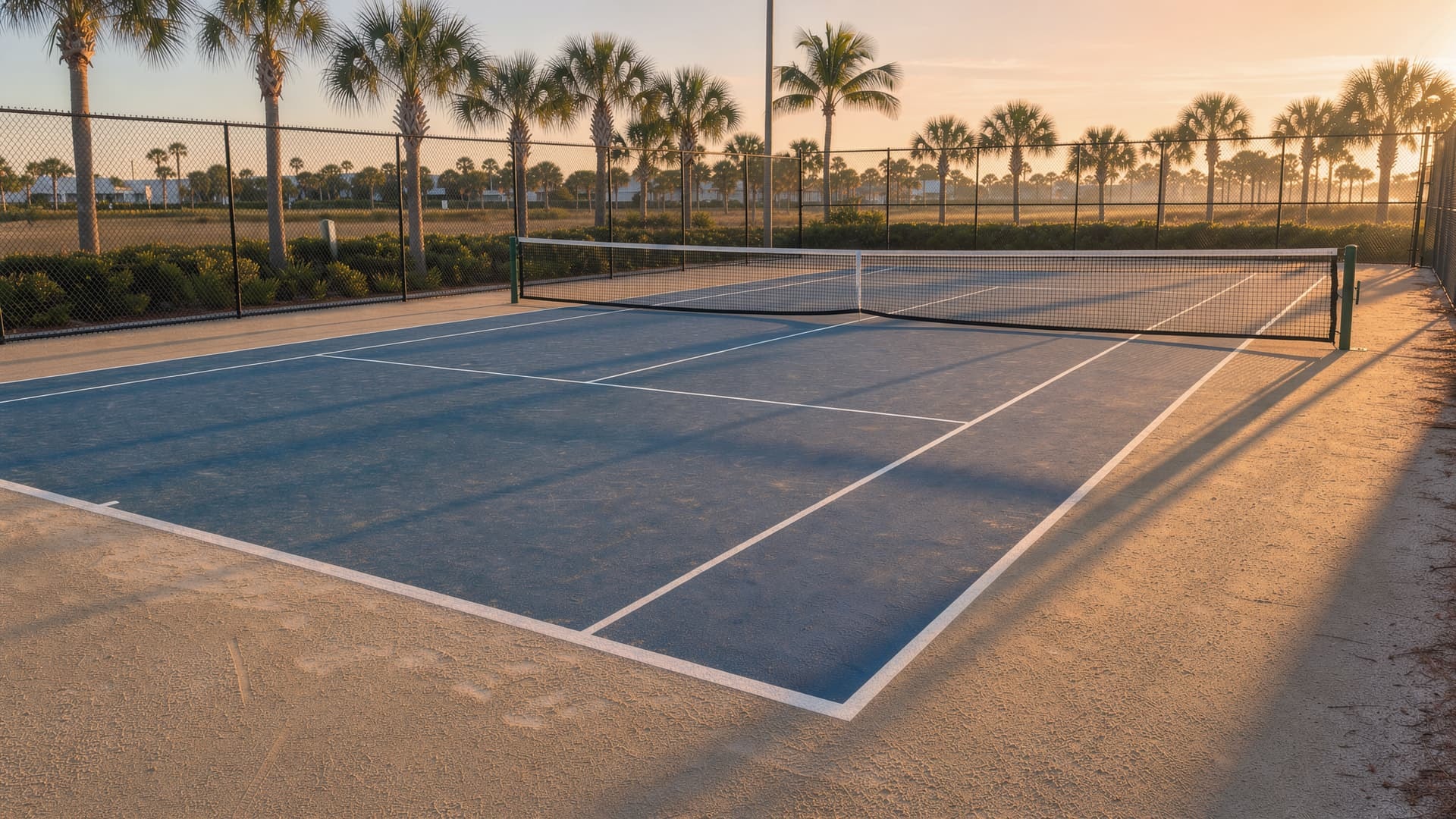
In tennis, the same painted rectangle serves two versions of the game. The court dimensions reference gives a narrower playing width for singles and a wider one for doubles. The inner sidelines and the strips outside them explain why a ball can be in during a doubles rally and out during a singles rally. The court diagram shows those strips alongside the lines that mark the serve's destination. A player can use the service boxes to understand where a serve lands. The rally that follows uses the court boundaries for that match.
There is a similar distinction in tennis scoring. The United States Tennis Association scoring guide separates the points played within a game from the games that make up a set. A tiebreak has its own point count. A scoreboard can therefore show a player ahead in the current game while trailing in the set. That distinction becomes easier to hear once the spoken score has been connected to the unit being counted.
The word racquet covers games that make very different use of space. USA Pickleball's rules summary describes a game across a net, with a strip near the net where players cannot volley. Squash is played with a small rubber ball in an enclosed court, and padel combines a net with an enclosure whose walls can come into play. The comparison in other racquet sports explains which boundaries matter during the rally and how the different scoring systems work.
In the water
Swimming and water aerobics use pool space differently. The water aerobics reference describes mostly upright movement in water, with resistance when the body moves and support from buoyancy. A swimmer doing laps works along the length of the pool. The competitive swimming reference distinguishes the main strokes and explains how the individual medley combines them. The U.S. Masters Swimming overview uses Masters to mean adult swimming and describes groups that also work with beginners. The label by itself tells a reader very little about how fast any particular group swims.
Minutes across a week
The federal Physical Activity Guidelines for Americans give adults a weekly range of 150 to 300 minutes of moderate-intensity aerobic activity alongside muscle-strengthening activity on at least 2 days of the week. The guidelines' questions and answers explain that short bouts of moderate or vigorous activity count. The office's intensity examples put brisk walking and dancing in the moderate category for a person of average fitness and list lap swimming and running as vigorous examples. The comparison describes effort, so the source notes that the same activity can fall in a different category for someone with a different level of fitness.
Heat and summer storms
The National Weather Service's Tampa Bay Area office describes the warm, humid thunderstorm season in West Central and Southwest Florida in terms of seasonal changes and daily sea breezes. It explains that when showers become frequent varies from year to year. The office distinguishes changes within that season, from a period when severe storms are most likely to one in which heavy rain and frequent lightning remain hazards. The heat and lightning reference explains how the National Weather Service separates a heat index reading from exposure in direct sun and what the agency says about stopping outdoor play for storms.
How the subjects are covered
The rules pages cite sports governing bodies and reference works. Activity pages identify the public agency behind a guideline, so the reader can tell a population-wide recommendation from a description of a particular class or sport. The recovery page uses public health references and research records for questions such as what a review measured and what its findings can say about a match. The material is general information. About Suncoast Court & Fitness explains how figures and sources are handled.