The group format describes how exercise is organized. Participants work through a routine together, usually with an instructor guiding transitions between movements. The aerobics reference describes rhythmic movement to music with stretching and strength work alongside aerobic activity. In indoor cycling, an instructor may lead the same ride pattern while each participant controls the effort through their own pedaling speed and resistance. Participants can follow the same timing while setting different levels of effort.
How group aerobics developed
The aerobics reference traces popular rhythmic group formats to writings on aerobic conditioning and the development of aerobic dance. Early aerobic conditioning included activities such as running, walking, swimming and cycling. Dance formats brought music and recognizable movement combinations into that approach. As instructors taught those patterns to groups, their steps could be repeated and combined in longer sequences. In the 1982 example in the aerobics history, the release of a home exercise video helped spread aerobics beyond the class setting.
The step aerobics reference describes the introduction of a short platform as a distinct development. It records research on step exercise in the 1980s and growing participation in the United States in 1990 in its historical summary. A routine around a step has its own patterns, including which foot leads and whether the next movement returns to the floor or changes direction. The same idea of a guided sequence can be taught with different equipment.
The aerobics description distinguishes cardiovascular conditioning from strength work and stretching within a class. Its formal class outline also includes a warm-up and a cool-down. A class can therefore feature a recognizable aerobic pattern in the middle while starting with easier movement and finishing with a different kind of work. These segments help explain why the class's name may describe just part of what happens in the room.
Classes built around rhythm or cadence
Dance fitness
In its section on aerobic dance, the reference describes an instructor combining short movements into a longer sequence. Teaching a few movements, repeating them and then putting the pieces together gives the class a way to learn the pattern while moving. The music gives the sequence a common tempo. The page on aerobic intensity explains why a routine's pace and the effort an individual experiences can differ.
Step aerobics
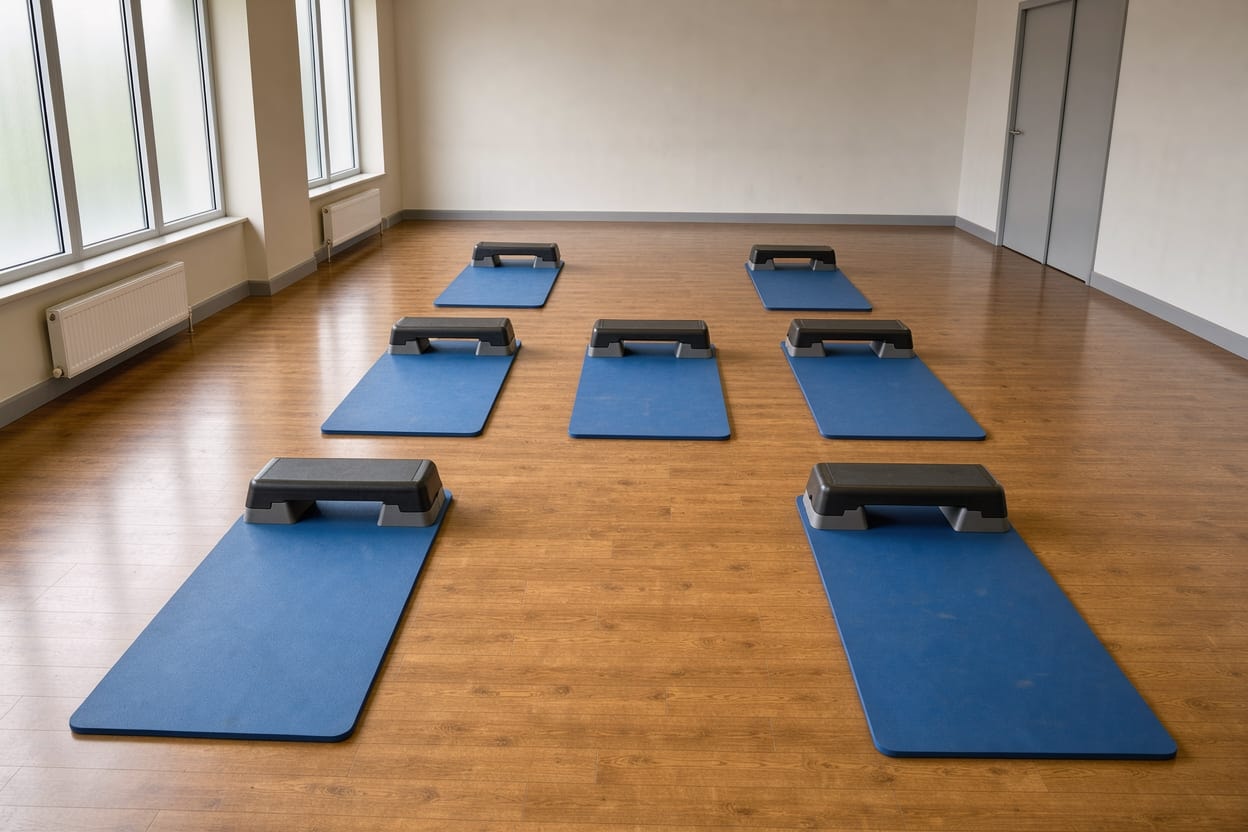
The movements in step aerobics repeatedly take the body up onto and down off an elevated platform. The aerobics reference describes platforms with removable risers and illustrates a basic sequence in which the feet go up in turn and come back down in turn. A lead-foot change can be enough to change which side begins the next sequence. The platform adds a change in level to movements that would otherwise stay on the floor.
Indoor cycling
An indoor cycling class uses stationary bikes with adjustable resistance and fitting points. A weighted flywheel gives the moving pedals momentum. The instructor can describe different parts of a ride as a climb, a sprint or a steadier stretch, drawing on situations familiar in outdoor cycling. The rider varies cadence and resistance. Cadence means how fast the pedals turn, while resistance is how hard they are to turn at that pace.
Classes built around exercises or efforts
Circuits and intervals
In circuit training, the planned exercises are performed in an order and can repeat from the beginning after the last one. The reference describes short transitions between exercises. An indoor example from MedlinePlus switches between muscle groups with movements such as squats and pushups. A rotation from exercise to exercise is what makes that pattern a circuit.
In high-intensity interval training, brief, very demanding efforts are separated by easier activity or rest. The effort can rise and fall within the same movement, as it does during a cycling interval. The reference describes a warm-up and cool-down surrounding a main block in which the intervals take place. A class can use a circuit and vary the effort within it. The short-session reference explains how the parts of a workout relate to its total duration.
Strength formats
Strength training includes lifting weights, moving against body weight and holding positions under tension. The aerobics reference lists barbells and small weights among equipment that may be used in group routines. A barbell-based strength segment uses the weight as outside resistance. Standing from a squat or pressing up from the floor can use body weight as resistance. The lifting reference describes grouping repetitions into sets and using rest periods between sets. The same sequence of lifts can be used with different amounts of resistance.
Classes built around control or support
Yoga and Pilates
The Pilates reference describes controlled movement with attention to posture, alignment, breathing and the muscles around the trunk. It discusses mat work and movements of different difficulty. Its comparison with yoga points out that some positions look alike in the two practices and distinguishes yoga's greater emphasis on flexibility from Pilates' emphasis on the trunk. The National Institute on Aging lists yoga among activities with a balance component, giving another way to understand why a format can span several kinds of work.
Water classes
The water aerobics reference describes group routines done mostly upright in water, with a mix of aerobic and resistance work. Buoyancy supports part of the body and water pushes back against movement. Water can therefore supply the resistance in an exercise without a weight held in the hand. The sections on pools and water exercise and components of fitness explain the difference between how an activity is organized and the capacity it asks of the body.
Sources
- Aerobics - Wikipedia
- Indoor cycling - Wikipedia
- Step aerobics - Wikipedia
- Circuit training - Wikipedia
- Indoor fitness routine: MedlinePlus Medical Encyclopedia
- High-intensity interval training - Wikipedia
- Strength training - Wikipedia
- Pilates - Wikipedia
- Three Types of Exercise Can Improve Your Health and Physical Ability | National Institute on Aging
- Water aerobics - Wikipedia