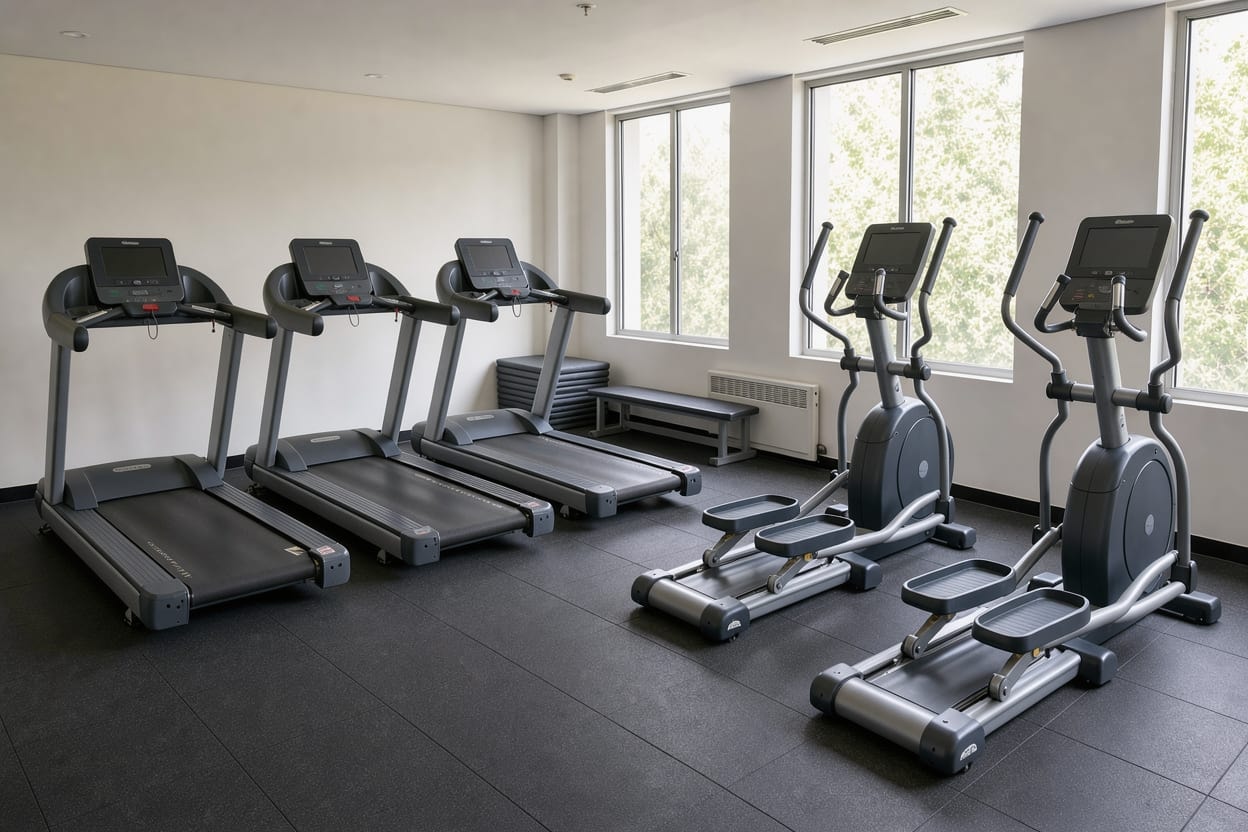
The part of the machine that meets the foot explains much of the difference. A treadmill's belt moves to the rear, and a person walks or runs at a matching pace. On an elliptical trainer, linked pedals guide the feet through a looping path. One machine puts a moving surface under each step. The other provides a moving support that stays with the foot through the stride.
How the motion works
The treadmill reference distinguishes powered models, where a motor drives the belt, from manual models, where the person's foot movement drives it. The belt passes over a running deck. In a powered model, the motor can keep it moving at a set speed, so maintaining position on the deck requires matching the pace. Raising the deck changes the pitch to simulate a climb. Some models vary those controls during a session to simulate terrain such as hills, as the treadmill reference describes.
The elliptical reference explains that the machine links moving parts so that a point on the mechanism follows an approximate ellipse, or stretched circle. The pedals supply a guided stride and the legs provide most of the driving force. On many models, moving handles are linked to the pedals. The arms can push and pull, sharing some of the work with the legs. Other models have stationary upper-body components.
How the machines compare
| Feature | Treadmill | Elliptical |
|---|---|---|
| Motion | Walking or running on a moving belt. | Stepping along guided pedal paths that form a stretched loop. |
| Impact | Successive footfalls on the moving surface. Some designs use a cushioned deck. | The heels keep contact with the pedals, a low-impact arrangement. |
| Typical controls | Belt speed and deck incline on powered models. | Pedaling speed and resistance, with an adjustable path or stride length on some models. |
| History | Earlier forms were used for power and later adapted for exercise. | Entered the exercise equipment market in the 1990s, drawing on mechanisms that guide a part along an elliptical path. |
Foot contact and muscle work
The treadmill reference explains that cushioning in a deck can make the impact slightly lower than during outdoor running. The foot still meets the belt at each step. The elliptical reference describes elliptical movement as low impact because the feet stay with the pedals, and it classifies the movement as weight-bearing. The terms refer to different features. Foot contact can stay continuous while the legs support the person's weight.
The elliptical reference describes work by the leg muscles in both kinds of exercise. It highlights the hips, hamstrings and calves for the elliptical, with the potential for the arms and shoulders to participate on models with moving handles. On some models, an adjustable ramp changes the angle of the pedal path and can change stride length. That is a change in geometry as well as effort. Resistance changes how difficult it is to move through that path. The components of fitness page explains the different meanings of muscle work and endurance.
Controls interact with the way each machine moves. On a powered treadmill, the set belt speed determines the pace a person has to match. In the elliptical description, the workload depends on how fast the pedals travel as well as on the selected resistance. The pedal speed and the resistance can describe different experiences on the same machine.
How these designs arrived indoors
Before the moving belt became exercise equipment, treadwheel and treadmill designs used repeated steps as a source of mechanical power. The reference describes machines that drove mills or lifted water. It also describes a period when a wheel with steps was used for hard labor in prisons. The history of the exercise treadmill records a training-machine patent in 1913 and a design for clinical exercise testing in 1952. The reference describes the development of a home model in the late 1960s.
The elliptical history puts the study of linked parts that trace an elliptical path in 1988 and the arrival of elliptical exercise machines in the 1990s. Each pedal travels through its own loop as part of a linkage, while a treadwheel rotates around its axle. The design also differs from an exercise bicycle, with leg motion between bicycle pedaling and a treadmill stride according to the reference.
The page on aerobic intensity covers how a person experiences effort, a question distinct from the setting of a speed, incline or resistance control. The group exercise overview describes another indoor format in which equipment controls and a shared sequence both affect the session.