Start with the exchange
A rally is the exchange of shots that follows the serve. The United States Tennis Association's basic description starts with players on opposite sides of a net trying to return the ball inside the court. In a regular match, rallies decide points, points decide games and games decide sets. An informal hit can concentrate on an exchange over the net without stopping to keep track of games.
The USTA's article for adults starting or returning discusses the forehand, backhand, volley and serve as the basic shots a beginner is likely to meet. They solve different problems. The serve puts the ball in play, while a volley meets a ball that is still in the air. A player can practice a backhand feed after feed without adding the separate task of starting each point with a serve.
The USTA describes ways to simplify early play, including beginning points without a serve, working in a smaller part of the court and using simpler scoring. When a pair is trying to keep a ball in play together, a short exchange can give both players repeated chances to make contact. In a scored match, the same shot that helps sustain a practice exchange may leave an opponent room to attack. The purpose of the session changes what counts as a good ball.
What the movement looks like
The USTA beginner article describes a range from low-key social play to short, intense efforts. In singles, the player has the whole width of the singles court to cover, while doubles gives a pair the wider court described in the court measurements. The space a player has to cover also changes as each shot pulls the players toward the sidelines, the baseline or the net. An exchange with another beginner is an opportunity to observe where a bounced ball arrives. In a competitive point, a player may need to cover space quickly and be ready for the reply as soon as the ball leaves the racket.
A 2007 review of competitive tennis described demands for speed, agility and power alongside aerobic capacity. Agility here is the ability to change direction, such as moving toward a ball and then reversing to cover an open part of the court. The review concerns competitive players. The beginner article's shorter-court examples show how an introductory exchange can ask less of a new player at once.
Rackets, balls and footwear
The USTA treats a racket and tennis balls as the basic equipment. The racket's handle is the grip, the stringed face sits inside the head and the throat connects the handle to the head. The equipment reference uses racket and racquet for the same object. Grip can also refer to how the hand holds the handle, as in the named grips in the USTA beginner article. A grip size describes the handle. A grip style describes the hand's position on it.
The USTA beginner article emphasizes how comfortably the handle fits in the hand. The head is a separate dimension. The racket reference describes how a larger head can give a player a broader useful area of strings when contact is away from the middle. It also describes twisting on some off-center hits, so head size alone gives only part of the picture. Weight, balance and string pattern vary across rackets as well.
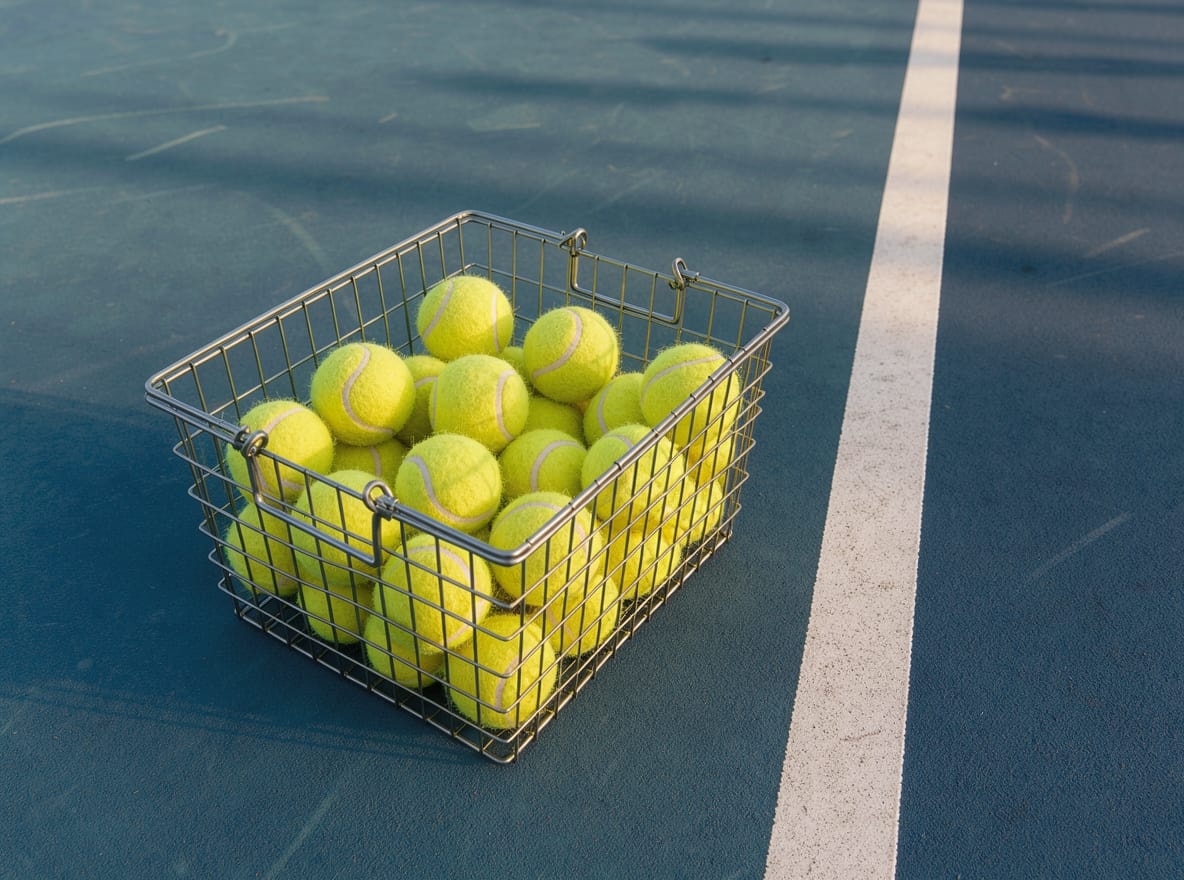
Conventional tennis balls have a hollow body covered in felt. The tennis-ball reference describes the International Tennis Federation's progression using slower balls and smaller courts for people learning the game, including adults. The red stage uses particularly slow balls, which can be oversized and unpressurized or made of foam rubber. Orange balls are the usual size with no pressurization, and green balls are the usual size with partial pressure. Smaller courts and slower balls can be used together. The ball's slower flight gives players time to prepare for the next shot, while the scaled court brings the lines closer together.
For footwear, the USTA beginner article points to supportive shoes with soles that avoid marking the surface. The article also describes hitting against a wall by a hard surface as a way to practice away from a full court. Against a wall, the incoming ball comes from the rebound of the player's own shot.
Different ways to spend time on court
The USTA describes informal hitting, clinics and lessons as options at different points. A private lesson gives an instructor time to observe one player's strokes. A group lesson or clinic gives players chances to hit with others while an instructor organizes the session. A drill is a repeatable task within a session, such as returning a series of balls to the same area. Social play can use the ordinary scoring rules or the simpler starts and scoring the article describes. The worked scoring example follows the change from an ordinary game to a set tiebreak.
Ratings, age groups and wheelchair play
The USTA's National Tennis Rating Program (NTRP) describes playing ability, with a scale from 1.5 for a beginner to 7.0 for a touring professional. The organization explains that an entry self-rating comes from a questionnaire for players beginning rated league play without a relevant rating. A computerized rating reflects match scores and the ratings of the other players involved. A player's ability in a single drill answers a narrower question than a rating based on match results.
Level is one organizing feature. The USTA also lists age divisions for adult and mixed competition. In wheelchair tennis, the USTA scoring reference describes a maximum of two bounces before the return. The ordinary tennis allowance in the same explanation is one bounce. The effect is on when a ball remains playable after it lands.
Public courts, leagues and ratings explains the kinds of places used for play and how the USTA uses match scores. Other racquet sports compares games with different bounces, boundaries and ways of starting a point.
Sources
- Tennis Scoring: Points, Sets & Games | Tennis Rules | USTA
- How to Start Playing Tennis (Or Pick the Racquet Up Again)
- Tennis court - Wikipedia
- Tennis physiology: training the competitive athlete (2007)
- Racket (sports equipment) - Wikipedia
- Tennis ball - Wikipedia
- USTA NTRP Ratings: FAQs | National Tennis Leagues | USTA