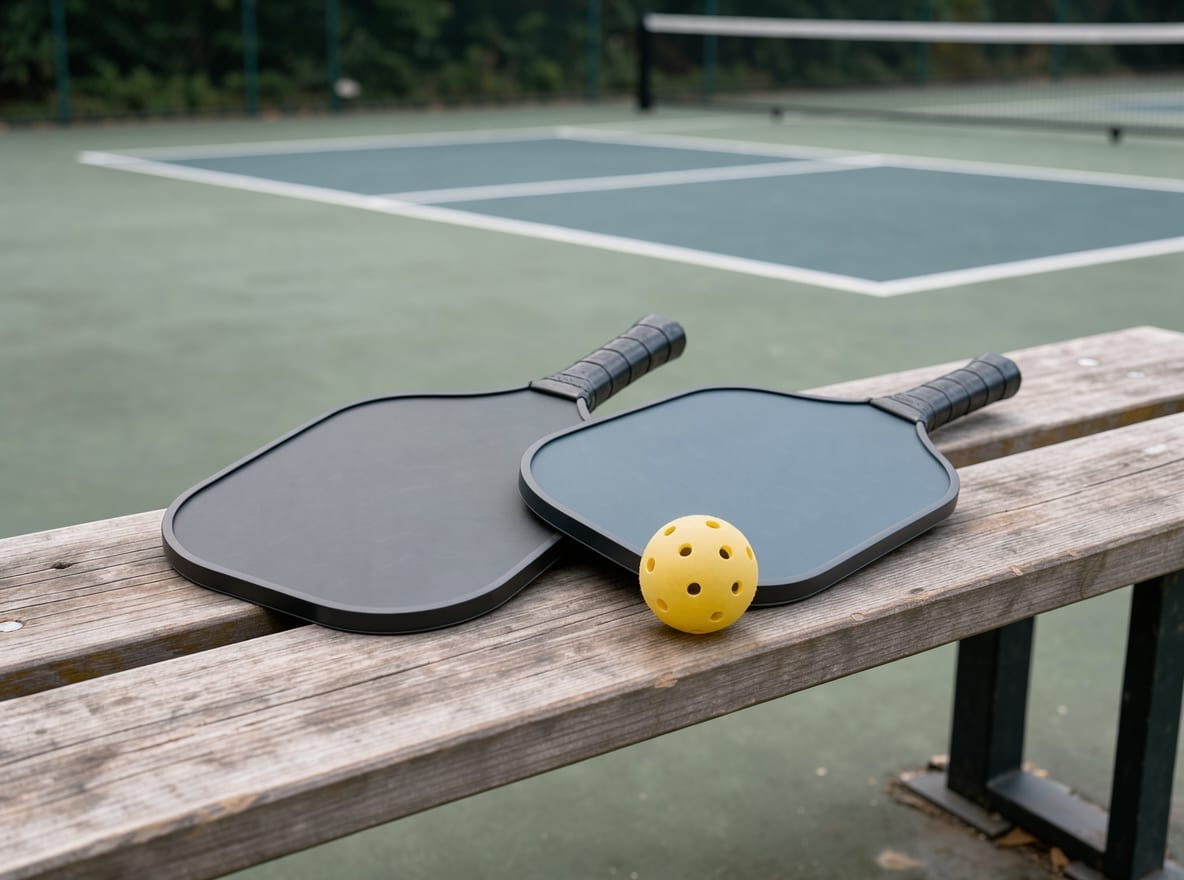
In pickleball and padel, the opponents begin on opposite sides of a net. Players in squash and racquetball share the floor and take turns playing toward the front wall. The distinction changes the meaning of a successful return. A ball that comes back off a wall can be an ordinary part of a rally in those games. The tennis court layout shows how boundaries work in an unenclosed net court.
Pickleball
Pickleball uses a smooth-faced paddle and a hollow plastic ball with holes. Its hard plastic ball bounces less than a tennis ball. The game can be played outdoors or indoors. The USA Pickleball rules summary says doubles is the more common format and both formats use the same size court. When a team has a partner, the players share the area they need to cover.
The summary describes a diagonal serve from behind the baseline with a single attempt. For the ordinary serve, the arm moves through an upward arc and the paddle meets the ball at or below the waist. A permitted drop serve has different requirements. The receiving side waits for the ball to bounce, then the serving side also plays its first return after a bounce. Once the ball has bounced on both sides, the players may hit it before or after its next bounce, subject to the non-volley zone.
The non-volley zone, commonly known as the kitchen, extends 7 feet from the net on each side. A volley is a shot struck before the ball bounces. The rule applies to the zone line and to the momentum of the volleyer. A player may stand in the zone to play a ball that has bounced. The pickleball reference describes a dink as a soft shot into the non-volley area used to limit an opponent's attacking options.
In traditional side-out scoring, the serving team alone can score. In that format, a typical game goes to 11 points with a margin of 2. In doubles, a team's service normally passes to its other player before it goes to the other team. The opening sequence is an exception with just one server before the receiving side takes over. USA Pickleball also describes rally scoring, in which either side can earn a point by winning the rally.
The pickleball reference's participation estimate puts the United States total at 19.8 million in 2024, up 311% since 2021. This is a national estimate.
Squash
Squash is played in an enclosure where players use strung rackets to send a small, hollow ball to the front wall. The equipment reference describes a rubber-compound ball whose bounce depends on the particular ball and how warm it is. The colored dots mark different levels of bounce. A cold ball rebounds very little. The enclosure and rubber ball give the rally a different rhythm from the exchange across a tennis net.
The squash court description distinguishes the service boxes marked on the floor from the service line on the front wall. That wall also has an upper boundary and a lower band called the tin. On a serve, the ball strikes the front wall above its service line and below its out line before it travels to the opposite back quarter. During a rally, it can strike the front wall above the tin and below the out line. Side and back walls are available within their marked boundaries, and a ball on an out line is out.
The shared floor can bring players into the way of one another. The interference rules as summarized by the squash reference distinguish cases that allow a replay from interference severe enough to award the point. The decision concerns such things as room to swing, access to the ball and space to direct a shot at the wall. For accredited tournaments, US Squash adult policy lists point-a-rally scoring to 11 and matches that are best of 5 games. Point-a-rally means the side that wins the rally earns its point regardless of who served.
Racquetball
Racquetball also uses a strung racket and a front wall. Its standard enclosed court is 40 feet long, 20 feet wide and 20 feet high. The court has floor markings for service and receiving positions. Its hollow rubber ball has a lively rebound. The racquetball front wall is playable down to the floor.
The racquetball rules description begins with the server bouncing the ball and striking it directly at the front wall. A legal serve reaches the floor beyond the short line, and the rules treat some patterns of wall contact on the serve as faults. The rally then uses a broader set of surfaces, including the ceiling. The return reaches the front wall before the ball hits the floor. It may get there by way of another playable surface.
The rule set published by USA Racquetball describes side-out scoring, with a point available to the serving side. In singles, winning the rally as receiver brings the serve over. In doubles, it can bring the serving partner's turn to an end before the receiving pair takes over. The rule page lists games to 15 points and an 11-point deciding game if each side wins one of the opening games. Under that format, the first side to the target wins unless a rule exception applies.
Padel
Padel is usually played as doubles on a small enclosed net court. The equipment description gives it a ball similar to a tennis ball with a little less pressure and a slightly smaller size. Its solid-faced racket has holes and has no string bed. The enclosure combines solid walls and mesh, and the court description explains where the panels and fences sit around the playing area.
The padel rules summary describes an underarm serve struck after a bounce, aimed diagonally into the opposite service box. The receiver plays the serve after a bounce. During a rally, an opponent's shot can bounce on the floor and then rebound off a wall before a player returns it. Sending a shot directly into the opponents' enclosure before the ball lands on their floor loses the point.
The padel scoring description follows tennis game scoring. Some formats use a golden point at deuce, when the next rally decides the game. The receiving team chooses the side from which that point is served. Tennis scoring explains the sequence that leads up to deuce and the ordinary advantage format.
Courts, equipment and scoring side by side
| Sport | Court size | Ball | Racket or paddle | Scoring |
|---|---|---|---|---|
| Pickleball | Same footprint for singles and doubles. The non-volley zone extends 7 feet from the net on each side. | Perforated hollow plastic. | Smooth-faced paddle. | Traditional side-out games typically go to 11, by 2. Rally scoring can award either side a point. |
| Squash | Four walls and size varies by format. A North American hardball doubles court is 45 feet by 25 feet. | Small hollow rubber-compound ball. | Strung racket. | Accredited tournaments use rally scoring to 11, in best-of-5 matches. |
| Racquetball | Standard court 40 feet long, 20 feet wide and 20 feet high. | Hollow rubber ball. | Strung racket. | USA Racquetball rules page describes side-out games to 15, with a deciding game to 11. |
| Padel | 20 meters long and 10 meters wide, enclosed with a net down the middle. | Tennis-like ball with less pressure. | Perforated solid racket. | Tennis scoring with an optional golden point at deuce. |
Scoring labels identify which part of the rules changes. A side-out exchanges service and may leave the score intact. A golden point settles a tied game. For the sources behind other court formats, see further reading.