From indoor walls to outdoor lines
Wikipedia's history of tennis traces an early form to jeu de paume, or game of the palm. According to its account of the game's origins, most historians place it in northern France in the 12th century, when players struck the ball with the palm of the hand. The game later used a glove. By the 16th century, that glove had given way to a racket, and play had shifted to an enclosed area with settled rules, according to the same historical account. That enclosed version is known as real tennis.
The walls help explain how different the earlier game was. The real tennis court reference describes a rectangular indoor floor with high walls, sloped roofs along some of those walls, and openings that affect play. The ends differ from one another, as do the sides. A ball played against the slope or wall can be part of the point, as the description of a real tennis serve shows. In the lawn game, the net divides the court into equal ends, and the marked rectangle, described in the modern court reference, sets the landing boundaries.
According to the history of lawn tennis, a version played on a croquet lawn in Birmingham, England, between 1859 and 1865 drew on racquet games and used an air-filled ball. The history of tennis balls describes other early lawn games on croquet lawns and balls made with air-filled rubber. Early rubber balls had no cover. A cloth covering and hollow pressurized core later became part of the ball described in the same account.
Why the court stayed rectangular
One design tried a much different outline. Wikipedia's history of lawn tennis says an hourglass court was designed in 1873 because a rectangular tennis court was already in use and could not be patented. The patent for the court was granted in 1874, according to that account. The outline narrowed around the net and widened toward the ends. Beyond that shape, the game also used a higher net, a diamond-shaped serving area, and a direction for serves that sent them beyond the service line.
The history dates a new set of lawn tennis rules to 1875 and says the first lawn tennis championship at Wimbledon used those rules in 1877. The hourglass design fell away with those early rules. Today's court layout makes the resulting arrangement clear: the sidelines run straight, the net lies across the middle, and a serve lands between the net and the service line. The court reference gives the uniform outline, which stays the same across surfaces.
Grass and the low bounce
Grass courts grow on firmly packed soil. The grass court reference describes a fast, low bounce that changes with the length and condition of the grass and the wear from recent play. Time between the bounce and the next shot can be short. The source associates that pace with shorter rallies and a greater role for the serve and the first volley, a shot taken before the ball bounces.
The grass itself needs regular mowing and watering, and the court reference notes that grass takes longer than hard courts to dry after rain. Those demands help explain why grass is much less common than it once was. Wimbledon has retained that surface, with grass at the championships since 1877, according to the summary of major tournament surfaces.
Clay and the higher bounce
The clay court reference describes a base of crushed stone and a fine loose layer above it. Red courts generally use finely crushed brick for that layer. Green clay uses crushed metabasalt, a stone that makes the surface slightly firmer and faster than red clay, according to the material comparison. The green variety is found especially in the mid-Atlantic and southern United States. The source describes the region broadly.
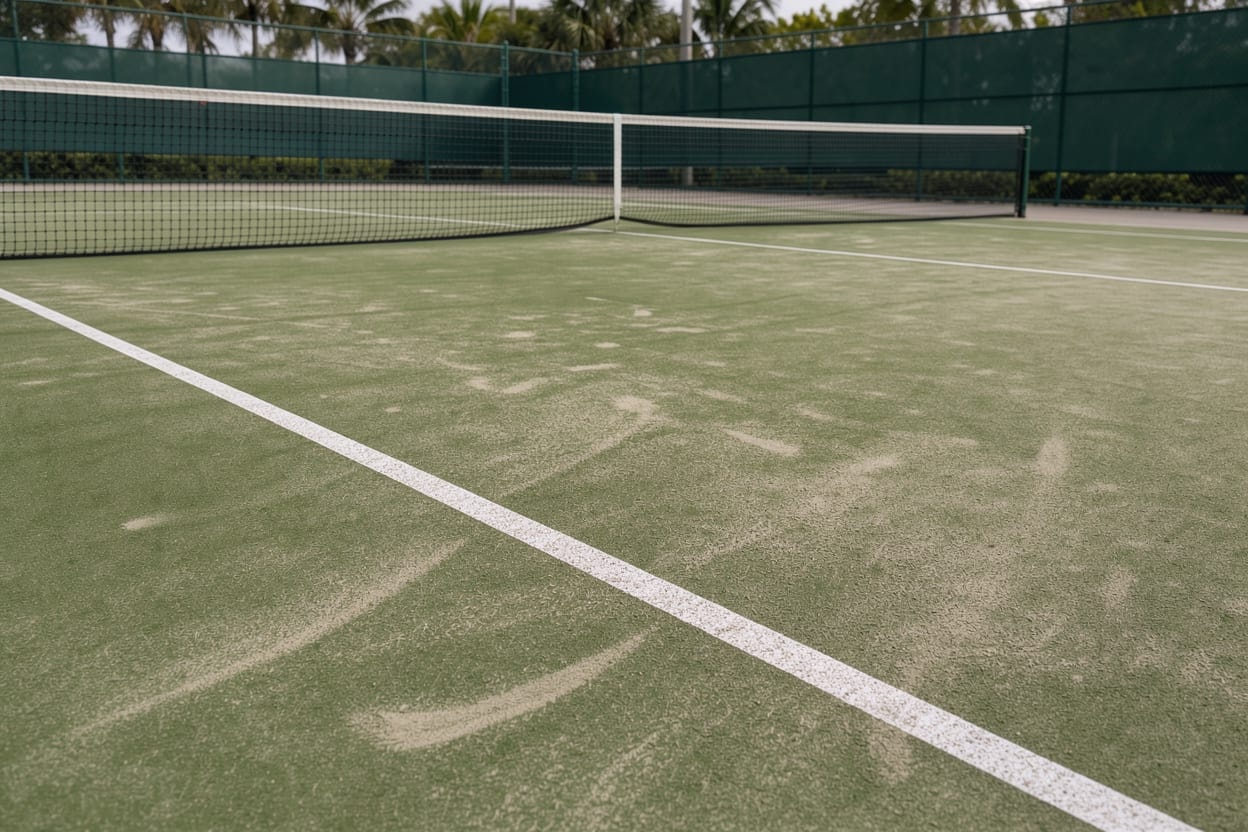
The clay court account describes the ball losing more speed at the bounce and coming up relatively high. A player at the baseline can have more time to reach a return, so points often last longer. The loose layer also changes how players move into a shot: sliding is common, and a bouncing ball can leave a visible mark. That mark records a different kind of contact from the one seen on grass or on a rigid court.
Early clay courts included ones dressed with powdered terracotta. The history of clay surfaces describes brick powder becoming a more available material, followed by a crushed brick and burnt shale design intended to drain more quickly. Clay still needs care. The clay court reference describes brushing, watering and rolling as ways to maintain texture and an even surface.
Hard courts and surface texture
A hard court typically starts with concrete or asphalt. The hard court reference describes an acrylic layer above that base and says that a greater amount of sand in that layer can slow the rebound because it adds friction. That variation matters even when courts have the same markings and both fall into the hard-court category. The court comparison describes hard courts as offering a more consistent bounce than other outdoor surfaces and generally playing faster than clay and slower than grass.
Hard courts also appear indoors. The indoor court reference distinguishes permanent courts on rigid foundations from temporary ones assembled from painted wooden panels. Another type of indoor surface was carpet, a removable covering that could be rolled out for play. The distinction is about surfacing and construction. The rectangle and net placement still follow the same set of court measurements.
Pace is measured separately from construction type. The court reference describes the International Tennis Federation's pace categories, which run from slow through medium-slow, medium and medium-fast to fast. A court described by its material still has a pace that depends on its particular surface. The texture of a hard court and the condition of a grass court are examples of what can vary within those broad types.
What the major tournaments play on
In the summary of Grand Slam surfaces, Wimbledon is the grass major, the French Open is played on clay, and the Australian Open and U.S. Open are played on hard courts. The French Open plays on a crushed red brick surface. The same account records different surfaces in the histories of the other tournaments. The Australian Open switched from grass to hard courts in 1988, while the U.S. Open switched from green clay to hard courts in 1978, according to the surface history.